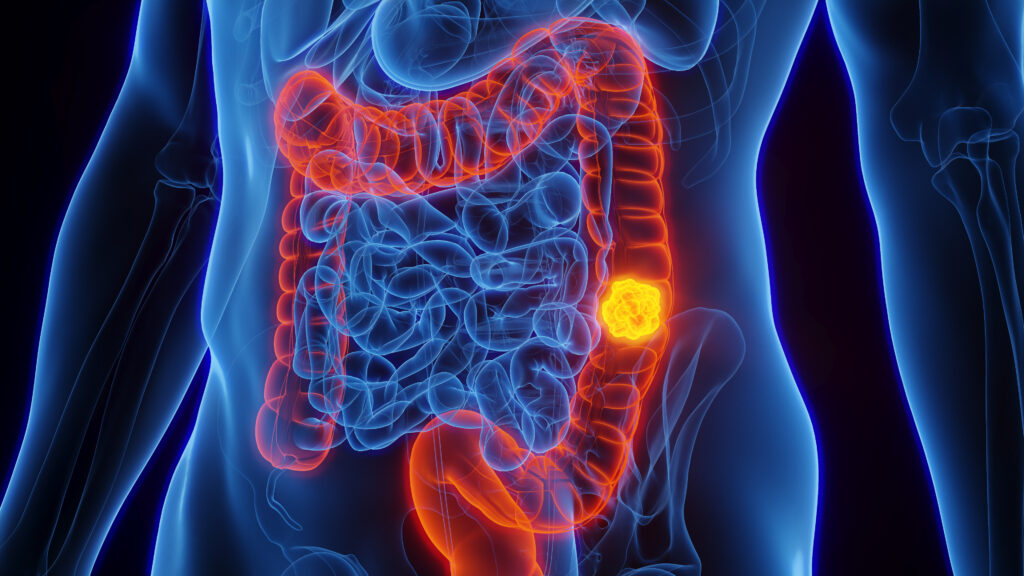
Colorectal cancer (CRC) is the second most common cause of cancer death in the United Kingdom, with approximately 17,000 deaths per year. A triage test to identify patients at risk of CRC could significantly improve survival and streamline referral pathways. Breath analysis offers a simple, quick and non-invasive method to detect volatile organic compounds (VOCs) in breath that are specific to CRC.
We carried out a discovery study (COBRA1) to identify potential VOC biomarkers to detect CRC in 855 symptomatic patients (709 controls, 146 patients with CRC). Fourteen VOC biomarkers for CRC were identified and we developed a detection model with an area under the receiver operating characteristic (AU-ROC) of 0.91, with a sensitivity of 83% and specificity of 88% [Gastroenterology. 2022, 163 (5), 1447-1449].
Aims
Methods
Discovery study identifying 14 VOC biomarkers for colorectal cancer in 855 symptomatic patients (709 controls, 146 patients with CRC). Detection model achieved AU-ROC of 0.91 in symptomatic patients and 0.87 including asymptomatic population. Published in Gastroenterology 2022.
Aims
Methods
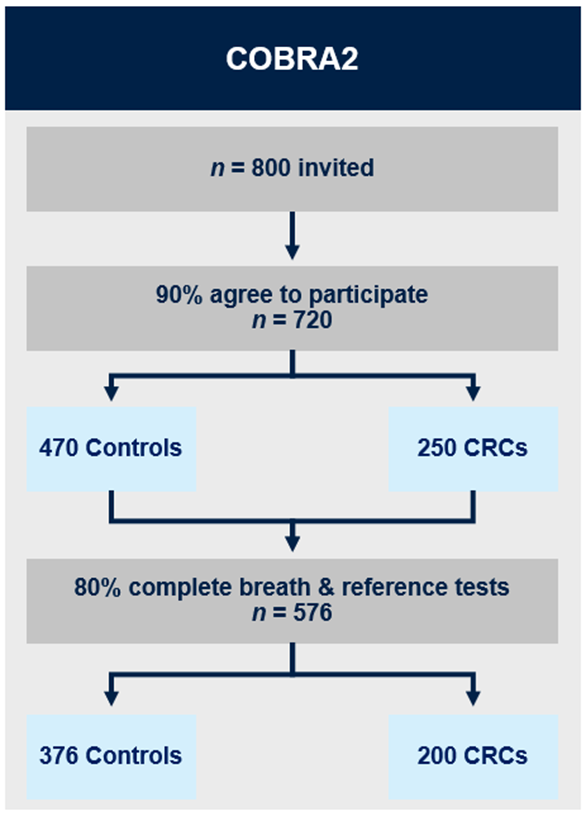
COBRA2 is a prospective multicentre validation study. Breath testing will be performed in 720 patients (470 controls, 250 patients with CRC) attending hospital for a planned colonoscopy or for resection of a histologically confirmed colorectal adenocarcinoma. Breath will be collected on to thermal desorption tubes and analysed with mid-polar, polar and two-dimensional gas chromatography-time of flight mass-chromatography (GC-MS-TOF) in our laboratory.
Recruitment to this trial takes place through participating NHS centres. If you think you may be eligible, please speak with your GP or hospital clinician who can refer you through the appropriate pathway.
Healthcare professional enquiries: Michael Fadel · m.fadel@imperial.ac.uk