In the UK, there are over 75,000 new cases annually of gastrointestinal cancers (oesophageal, gastric, pancreatic, liver and colorectal). The overall 5-year survival for these cancers is poor and even lower in deprived areas. Symptoms related to GI cancers are non-specific, making referral decisions challenging. Currently, the cancer yield of urgent and non-urgent referral pathways is 4.4–5.0% and 0.1–1.7% respectively. Breath analysis offers a simple, quick and non-invasive triage method that would maximise patient compliance, particularly in certain ethnic groups and deprived areas.
Aims
Methods
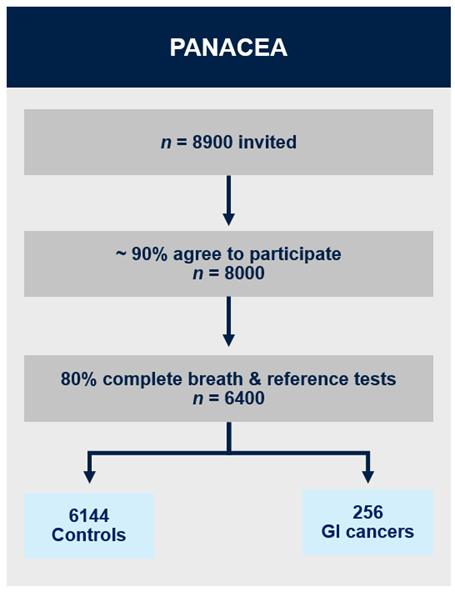
PANACEA is a prospective multicentre clinical study. At least 8,000 individuals with suspected cancer, referred from primary care along upper and lower gastrointestinal cancer pathways, will be recruited from 40 centres. We aim to have 256 cancers and 6,144 controls with complete dataset (reliable breath data and results of reference test). Breath samples will be collected on thermal desorption tubes which will be analysed using gas chromatography-mass spectrometry. We will examine diagnostic accuracy of the breath test to detect cancer and estimate the most likely cancer from upper and lower gastrointestinal referral pathways.nnThe views of key stakeholders will be captured through interviews, workshops and digital platforms and their feedback will be integrated into strategic decision-making, public engagement and awareness campaigns.nnMultiple implementation models will be co-designed and tested for breath test delivery in primary care. Process evaluation will be conducted across three sites to determine the strengths and weaknesses of the models. Guidance on best practice in breath test delivery for primary care will be developed.nnLastly, a cost-effectiveness and budget impact analysis will be performed to understand the affordability and financial impact on the NHS.
Recruitment to this trial takes place through participating NHS centres. If you think you may be eligible, please speak with your GP or hospital clinician who can refer you through the appropriate pathway.
Healthcare professional enquiries: Michael Fadel · m.fadel@imperial.ac.uk